Preventing application loss in EU recruitment system
Ensuring temporary staff don't lose access to results of job competitions
Overview
In EU institutions, recruitment works differently than in private companies. Periodically, competitions are opened for permanent positions, and applicants need to register and submit documents via an online platform.
A critical issue was that some applicants, especially those on temporary contracts within EU institutions, could lose access to their submission if they logged in using their institutional account. This could potentially result in missed opportunities. Meanwhile, permanent employees could safely use the same account, so solutions needed to serve different user types.
The project’s goal was to prevent applicants on temporary contracts from losing access to their submissions, while staying compliant with legal and system constraints.
My role
UX/UI Design
Tools used

Research
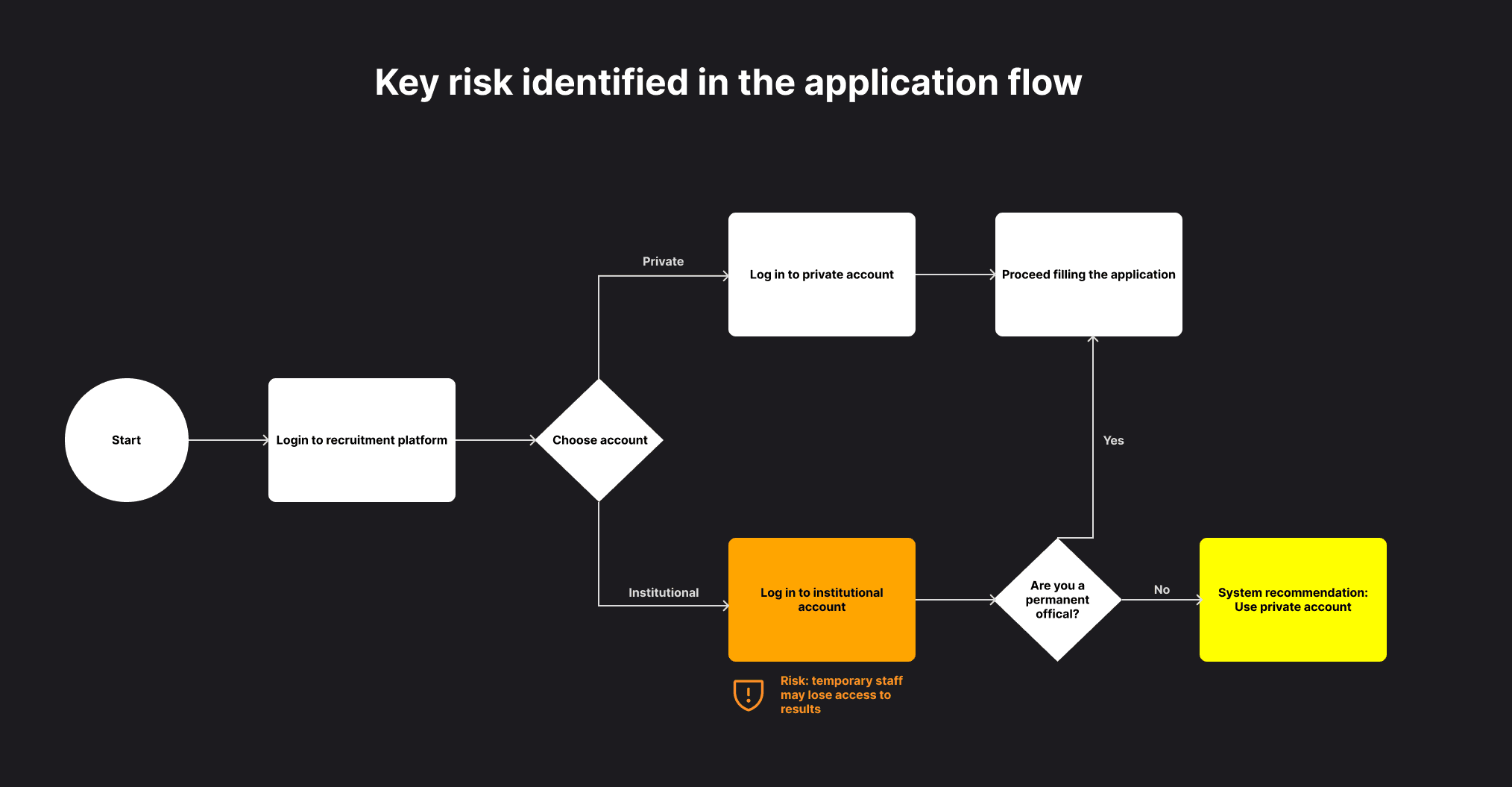
To understand the problem, I mapped the full application process. Key questions included:
How do users interact with the platform?
What are the main entry points and steps in applying for competitions?
Where do errors or confusion typically occur?
Mapping the process highlighted critical pain points, such as automatic logins on institutional devices, and misunderstanding of account types. This gave a clear picture of the user journey and helped identify the areas where intervention would be most impactful.
Design & actions
Legal and system limitations ruled out some obvious solutions, such as merging personal and institutional accounts or mandating additional personal information fields. I designed a multi-layered safety system to address the problem:
Visual cues - indicators showing which account is currently active, helping users immediately recognize if they are on an institutional account, especially on shared or work devices.

Popup alert - shown when an applicant is logged in with an institutional account, explaining potential risks while trying to apply for competition.
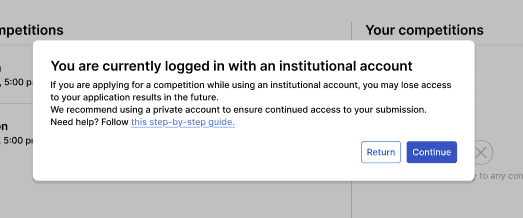
Step-by-step guide - linked from the popup, providing clear instructions for different scenarios, tailored to users with varying digital skills and language backgrounds.
These solutions were reviewed and approved in collaboration with Product Owners and technical teams before moving to user testing.
User testing
Outcome
Although exact platform metrics are not publicly available, the implemented system:
Helped users clearly identify which account they were using.
Reduced confusion and the risk of losing access to submissions.
Was accepted by Product Owners and technical teams for deployment, meeting both user needs and legal constraints.
The project demonstrates how design decisions grounded in research, empathy, and system understanding can prevent critical errors and improve the user experience in high-stakes digital processes.